Healthcare
The Denial Machine
One in five claims gets denied on the first pass. A system that says no to a fifth of everything is not making mistakes. It is doing exactly what it was built to do.
Start with the number, because the number is the argument. One in five claims gets denied on the first pass. Not the fringe cases. One in five. A system that says no to a fifth of everything is not making mistakes. It is doing exactly what it was built to do.
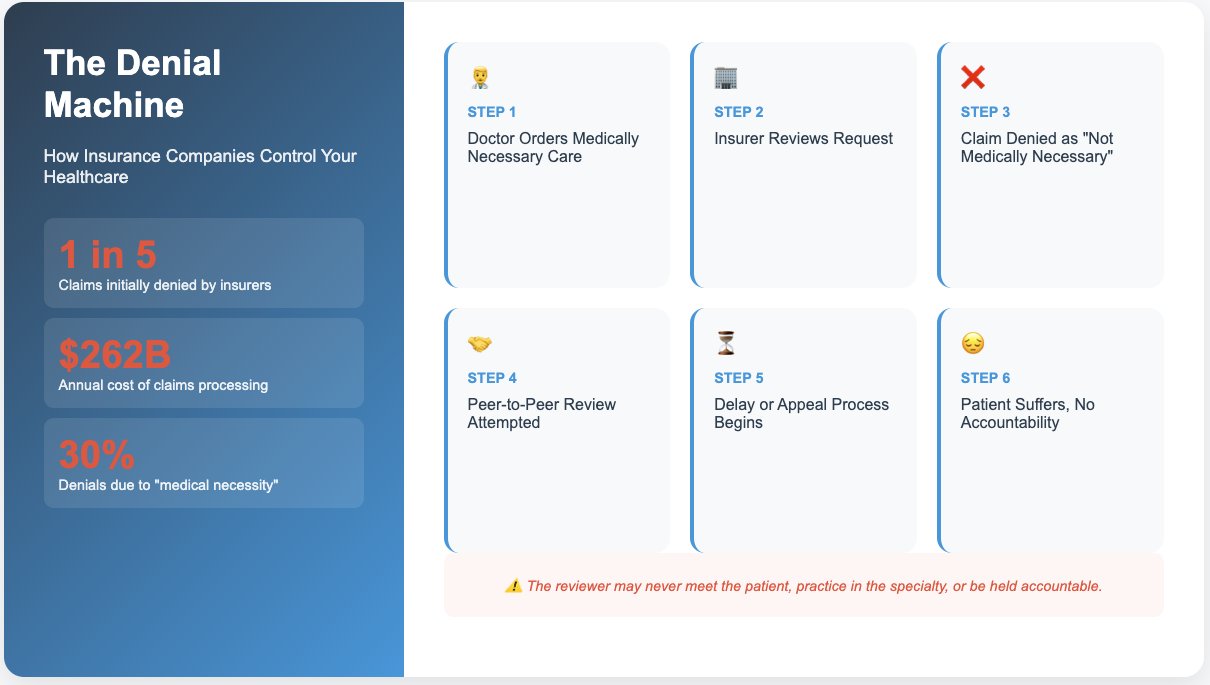
Here is how it works. Your doctor orders care. The insurer routes the request to a reviewer, a “payer physician,” a doctor on the insurance company’s payroll. That reviewer often does not practice, is frequently not board-certified in the specialty involved, never sees you, and faces no consequence for being wrong. The claim comes back stamped “not medically necessary” by someone who never examined the patient it was necessary for.
The denial is not a bug in the business. It is the business. Coverage is the marketing. Denial is the model. Every no that sticks is margin, and the machine is tuned to make no stick.
Watch what happens when a doctor pushes back. There is a “peer-to-peer” review, a phone call to argue the case. The call is not recorded. The reviewer is often in the wrong specialty. There is no transcript, no audit, no accountability, and the denial is rarely overturned. Even excellent doctors reverse only about half. That number will fall the moment insurers realize that overturning a denial could get their own reviewer penalized.
The cost lands on the people with no leverage. A cancer patient is prescribed an FDA-approved drug and denied. By the time an appeal or a charity closes the gap, weeks are gone, and the cancer is not waiting. A patient walks into the ER with chest pain, gets admitted and stabilized, and days later the insurer calls the stay “unnecessary” and the hospital eats it. Nobody signs their name to the harm.
We have a name for this when a foreign adversary does it. If someone killed thousands of Americans a year, drained billions, and hollowed out trust in medicine, we would call it a national emergency. When an insurer does it quietly, we call it claims adjudication.
The fix starts where there is leverage, and that is Medicare, where the government can actually enforce. Track payer doctors by NPI and ban the repeat offenders. Record and transcribe every peer-to-peer. Match reviewers to the specialty they are ruling on. Auto-approve when the insurer blows the deadline. Stand up an independent review board. And bar the insurer-owned firms from grading their own homework.
None of that is bureaucracy. It is the opposite. It is putting a name back on a decision that was built to have none.